markovkit
markovkit is a C++20 library for continuous-time Markov chains and stochastic reaction
networks, built on numerics. It solves the chemical master equation by finite state projection,
simulates paths with the SSA, models reaction-diffusion on meshes, and accelerates simulation by
eliminating subnetworks of states.
Source: github.com/AdityaDendukuri/markovkit
Setup
markovkit expects numerics in the adjacent directory.
git clone https://github.com/AdityaDendukuri/numerics.git
git clone https://github.com/AdityaDendukuri/markovkit.git
cd markovkit
cmake -S . -B build -DCMAKE_BUILD_TYPE=Release
cmake --build build -j8
ctest --test-dir build --output-on-failure
#include <markovkit.hpp> includes FSP, SSA and RDME. #include <subsweep.hpp> includes
subnetwork sweeping.
What it has
| Module | Contents |
|---|---|
cme/ |
Reaction systems, finite state spaces, and the generator on a state space |
fsp/ |
solve_adaptive_fsp, flux-controlled state-space growth; solve_krylov_fsp, Krylov propagation with the Vo--Sidje mass-loss criterion |
ssa/ |
gillespie, the exact direct method; tau_leaping, approximate Poisson leaping |
rdme/ |
Reaction-diffusion master equation on structured or unstructured voxel meshes, with population multigrid preconditioners for GMRES |
subsweep/ |
Subnetwork sweeping: eliminate a subnetwork of states, then sample where and when the chain leaves it |
A first model
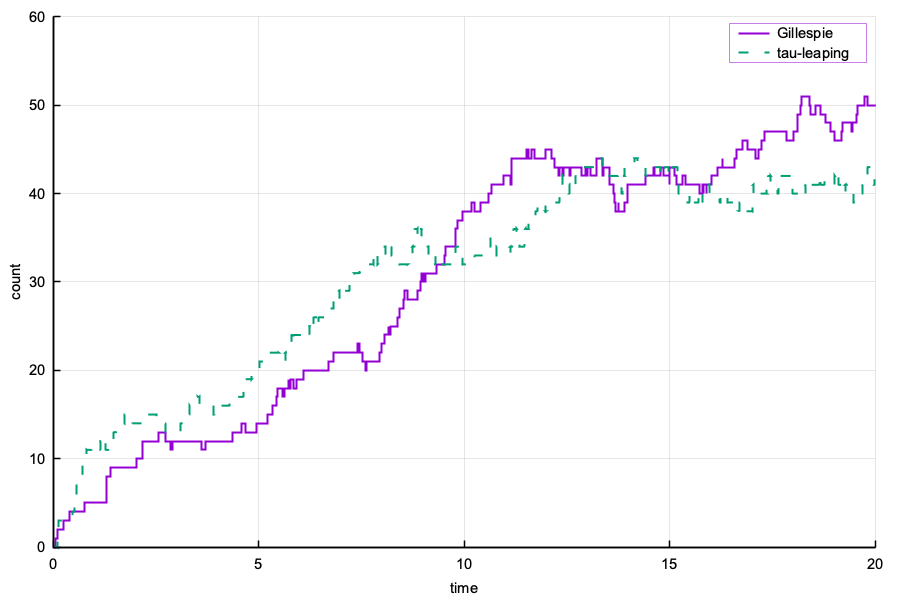
A birth-death process, simulated exactly and by tau leaping:
#include "markovkit.hpp"

int main() {
    markovkit::reaction_system model;
    model.changes = {{1}, {-1}};
    model.propensities = {
        [](const markovkit::state &, const num::array<double> &r, double) { return r[0]; },
        [](const markovkit::state &x, const num::array<double> &r, double) { return r[1] * x[0]; }};

    const num::array<double> rates = {5.0, 0.1};
    const markovkit::state initial{0};

    const auto exact = ssa::gillespie(model, rates, initial, 0.0, 20.0, 42);
    const auto approximate = ssa::tau_leaping(model, rates, initial, 0.0, 20.0, {}, 42);
}
Subnetwork sweeping
A sweep grows a subnetwork of states around the current state, solves for the distribution of
where and when the chain first leaves it, and jumps there. The linear algebra is chosen by
sweep_settings::regime:
| Regime | Factorization |
|---|---|
dense |
Retained inverse, initialized by Cholesky for reversible chains and LU otherwise |
block |
Block-tridiagonal LU, reusing the factors of unchanged blocks |
block_cholesky |
Block Cholesky with the same reuse, for reversible chains |
sparse |
Sparse LU, refactored for each subnetwork |
automatic |
block when the model supplies levels, sparse otherwise |
sweep_settings settings{.capacity = 120, .depth = 1, .regime = regime::block};
auto walkers = subsweep_walkers(rate_oracle, initial, walker_count, final_time, settings);
Examples
| Program | Shows |
|---|---|
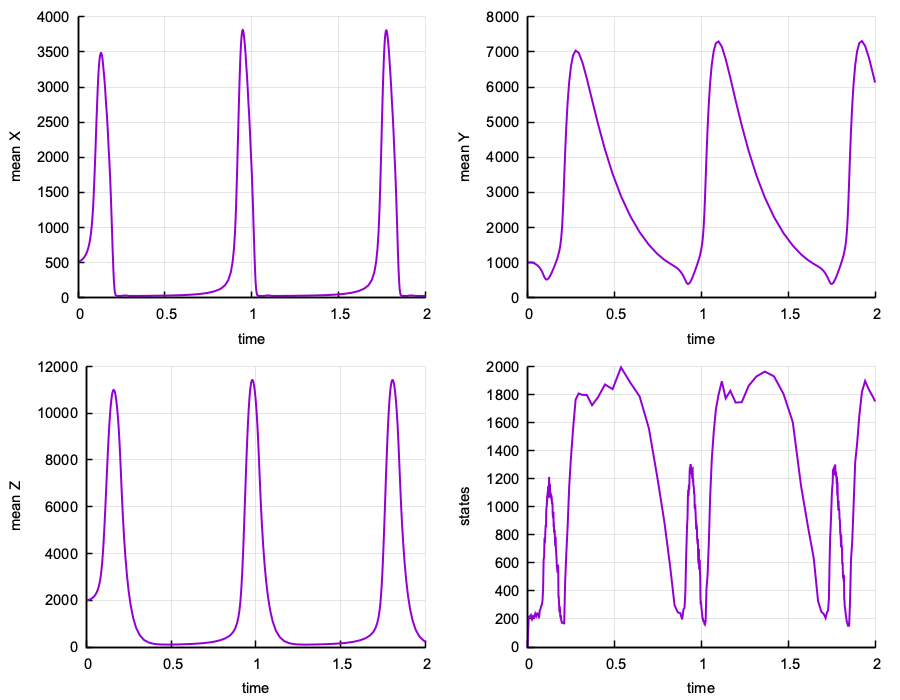
fsp_oregonator |
Adaptive FSP for the Field--Körös--Noyes oscillator |
fsp_toggle_switch |
Adaptive FSP for a bistable genetic switch |
ssa_birth_death |
Gillespie SSA against tau leaping |
rdme_multigrid_benchmark |
Plain and multigrid-preconditioned RDME GMRES scaling |
rdme_two_particle_annihilation |
Reaction-time statistics for diffusing A + B -> 0 |
rdme_multigrid_analysis |
Smoothing and two-grid analysis on fixed-population configuration graphs |