07_fourier_transforms.cpp
Compute the Fourier transform of complex and real data, and its inverse.
fft and ifft transform complex vectors, and rfft and irfft transform real ones, keeping the n/2 + 1 non-negative frequencies. The inverse transforms are unnormalized, so dividing by n recovers the input. The caller sizes the output vectors. The backend defaults to the SIMD path when the target has one, else the portable one, and each call can name one explicitly.
#include <cmath>
#include <io/json.hpp>
#include <numbers>
#include <numerics.hpp>
#include <string_view>
#include <vector>

using namespace num;
using namespace num::spectral;

int main(int argc, char **argv) {
    const bool plot = argc > 1 && std::string_view(argv[1]) == "--plot";
    io::json results = {{"simd_available", has_fft_simd}};

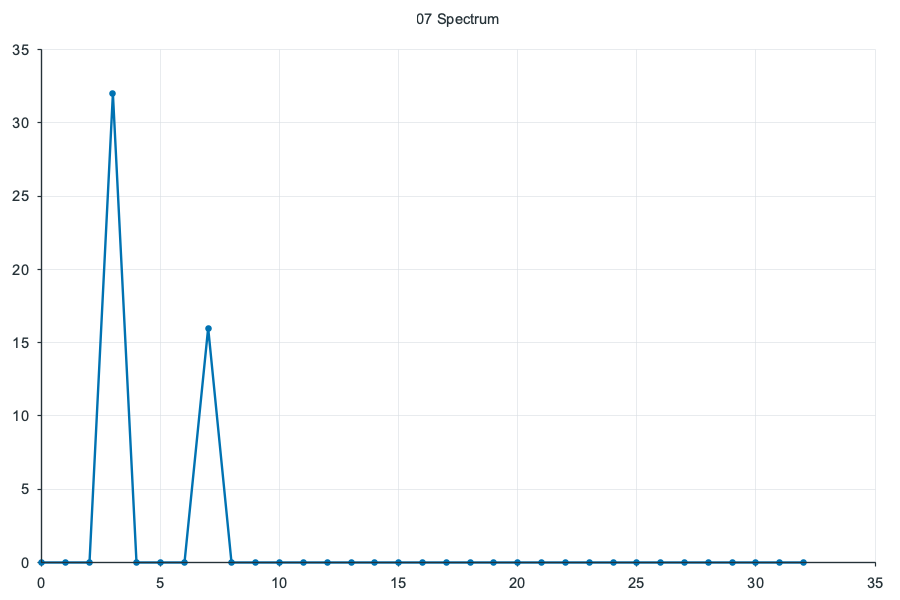
    // A signal with components at frequencies 3 and 7.
    constexpr idx n = 64;
    vec<real> signal(n);
    for (idx i = 0; i < n; ++i) {
        const real t = 2.0 * std::numbers::pi * static_cast<real>(i) / n;
        signal[i] = std::sin(3.0 * t) + (0.5 * std::cos(7.0 * t));
    }

    vec<cplx> spectrum((n / 2) + 1); // rfft writes the n/2 + 1 non-negative frequencies
    rfft(signal, spectrum);
    results["frequency_bins"] = spectrum.size();
    results["peaks"] = io::json::array();
    for (idx k = 0; k < spectrum.size(); ++k) {
        const real amplitude = 2.0 * std::abs(spectrum[k]) / n;
        if (amplitude > 0.01) {
            results["peaks"].push_back({{"frequency", k}, {"amplitude", amplitude}});
        }
    }

    vec<real> back(n);
    irfft(spectrum, static_cast<int>(n), back);
    real error = 0.0;
    for (idx i = 0; i < n; ++i) {
        error = std::max(error, std::abs((back[i] / n) - signal[i]));
    }
    results["real_round_trip_error"] = error;

    // Complex round trip, through the portable backend by name.
    vec<cplx> z(n), Z(n), z_back(n);
    for (idx i = 0; i < n; ++i) {
        z[i] = cplx(std::cos(0.3 * i), std::sin(0.1 * i));
    }
    fft(z, Z, fft_backend::seq);
    ifft(Z, z_back, fft_backend::seq);
    error = 0.0;
    for (idx i = 0; i < n; ++i) {
        error = std::max(error, std::abs((z_back[i] / static_cast<real>(n)) - z[i]));
    }
    results["complex_round_trip_error"] = error;
    io::write_json(results, "result.json");

    if (plot) {
        std::vector<double> k, magnitude;
        for (idx i = 0; i < spectrum.size(); ++i) {
            k.push_back(static_cast<double>(i));
            magnitude.push_back(std::abs(spectrum[i]));
        }
        plt::plot(k, magnitude, "|X(k)|", "linespoints");
        plt::title("07 Spectrum");
        plt::savefig("plot.png");
    }
}
Saved result:
{
  "complex_round_trip_error": 2.0411201962889075e-15,
  "frequency_bins": 33,
  "peaks": [
    {
      "amplitude": 1.0000000000000002,
      "frequency": 3
    },
    {
      "amplitude": 0.5000000000000001,
      "frequency": 7
    }
  ],
  "real_round_trip_error": 2.220446049250313e-16,
  "simd_available": true
}